 VivaKit
Waste Sorting with Deep Learning
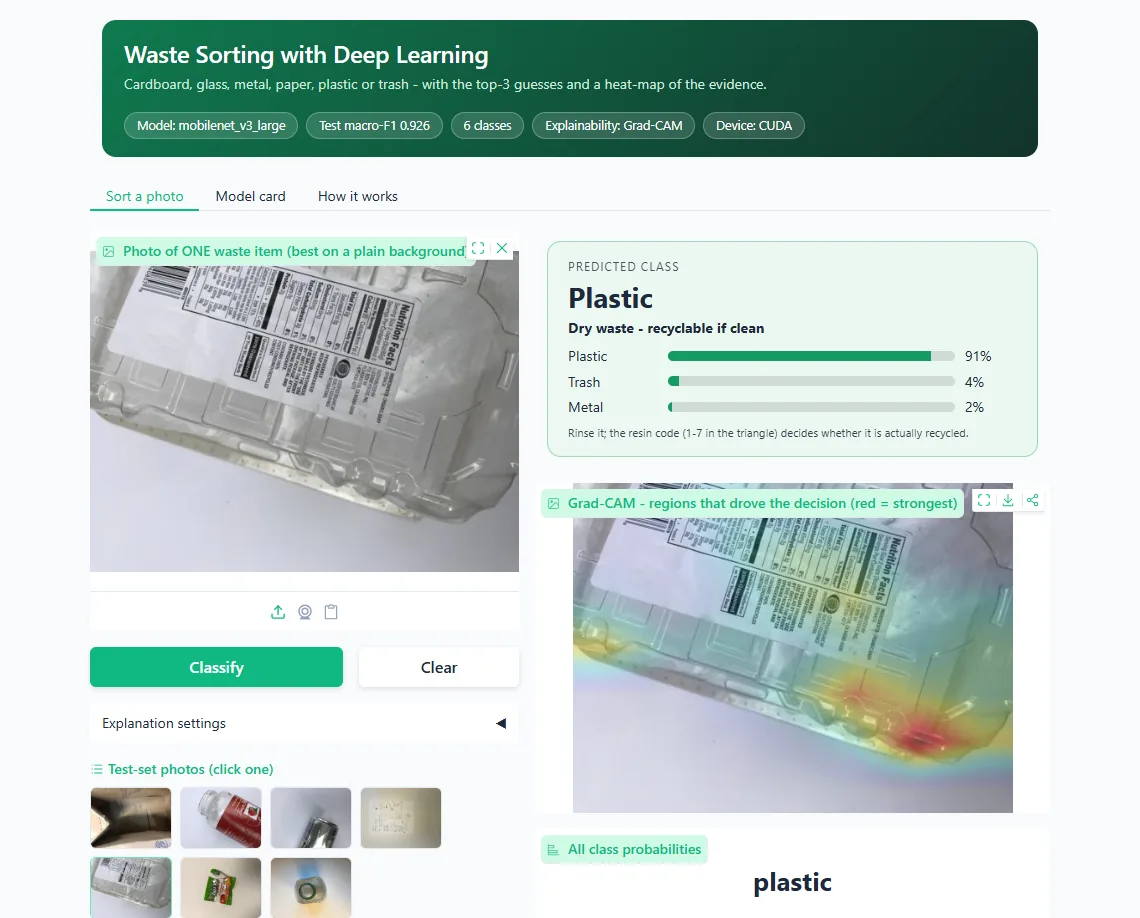
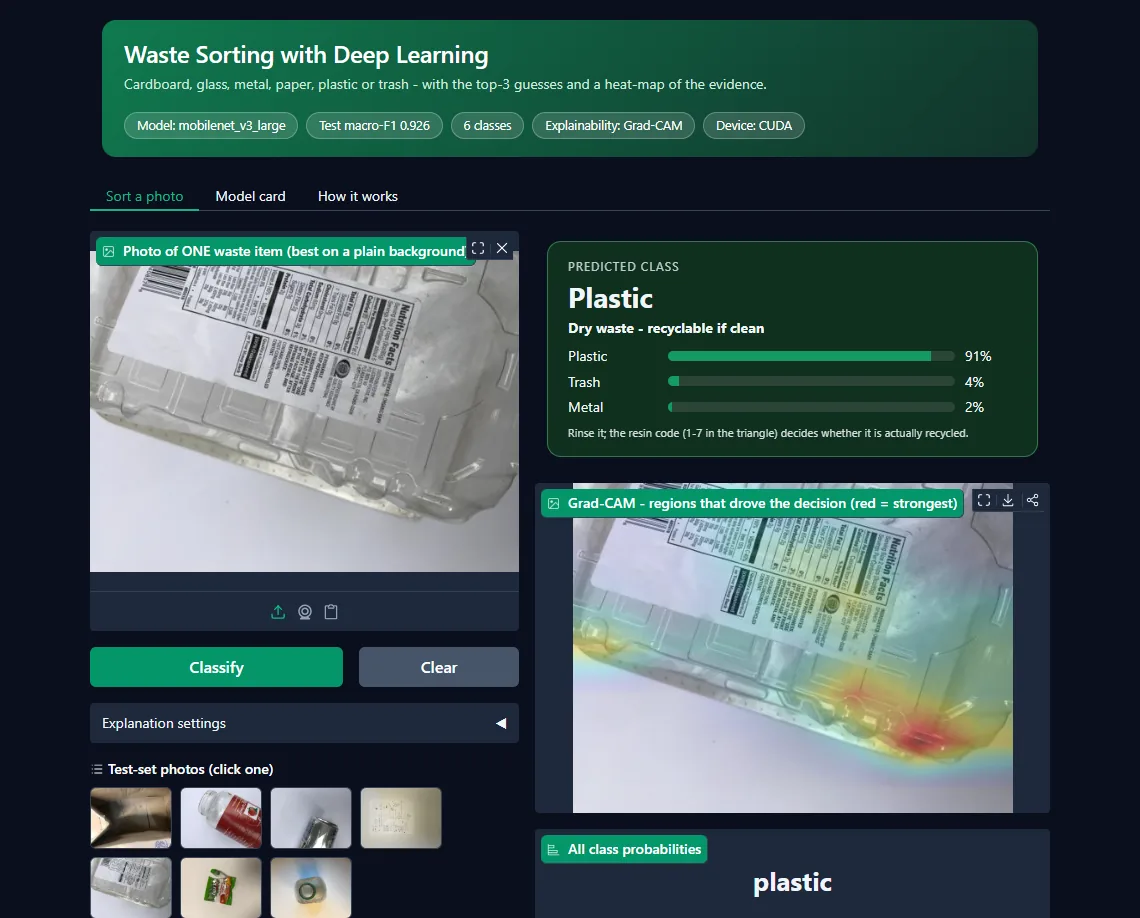
Photograph one waste item (upload or webcam) and see whether it is cardboard, glass, metal, paper, plastic or trash, the top-3 guesses, the dry-waste bin it belongs in, and a heat-map of the evidence. A small phone-sized CNN (MobileNetV3), fine-tuned on the TrashNet photos, beats three baselines on the same test photos, and the guide shows exactly where it still goes wrong.
Secure checkout by Dodo Payments (UPI, cards). Your personalised download link is e-mailed within 24 hours. One purchase covers one project team of up to 4 students. See terms and refunds.
Our honest results
| Fine-tuned MobileNetV3 accuracy - 379 held-out test photos | 0.942 |
| Macro-F1 (frozen CNN baseline: 0.859; colour histogram: 0.730) | 0.926 |
| Plastic called glass / glass called plastic | 5 of 72 / 0 of 75 |
| Accuracy on test photos with no near-twin in training (255) | 0.918 |
Some objects were photographed twice, so the test set has partly seen them: the guide measures that, and shows that a colour histogram of only the photo's border already scores 0.69 (a background shortcut). The demo runs on any laptop CPU; training takes 3 min on a GPU or about 25 min on a fast laptop CPU.
What's included
- Readable source codeSmall, commented modules you can explain line by line in your viva.
- Demo appA local web app to show your examiners - runs offline on your laptop.
- Trained model + reference resultsSo you can compare your own runs fairly.
- Learning guide with viva Q&ABackground, design choices explained, limitations and extension ideas.
- One-click setup & testsWindows setup script and tests that prove it works on your PC.
- Dataset download scriptFetches the public data from its original source, with the citation.
Dataset credit
Thung G., Yang M. (2016). TrashNet. Stanford CS 229 project. github.com/garythung/trashnet - MIT licence.
Academic integrity
We sell code and teaching, not finished projects. You must understand, extend and write up the work yourself, acknowledge the kit and cite the dataset. No ready-made reports.