 VivaKit
Retinal OCT: CNV, DME, Drusen or Normal
Four-class transfer learning on 83,484 retinal OCT scans, patient-wise splits, class weighting, macro-F1 and a screening view. The guide shows why this dataset's famous 99.9% test accuracy is a trap - and how to report an honest result your examiner will respect.
Secure checkout by Dodo Payments (UPI, cards). Your personalised download link is e-mailed within 24 hours. One purchase covers one project team of up to 4 students. See terms and refunds.
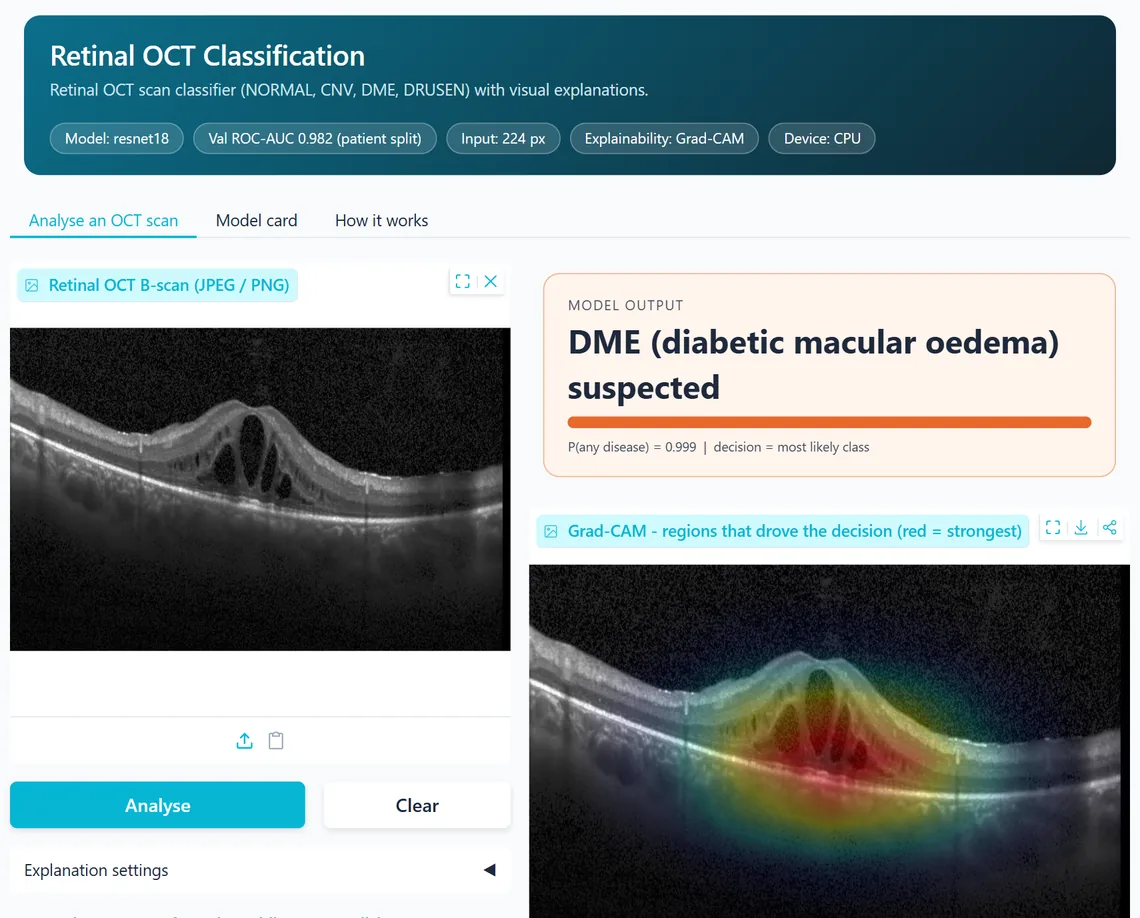
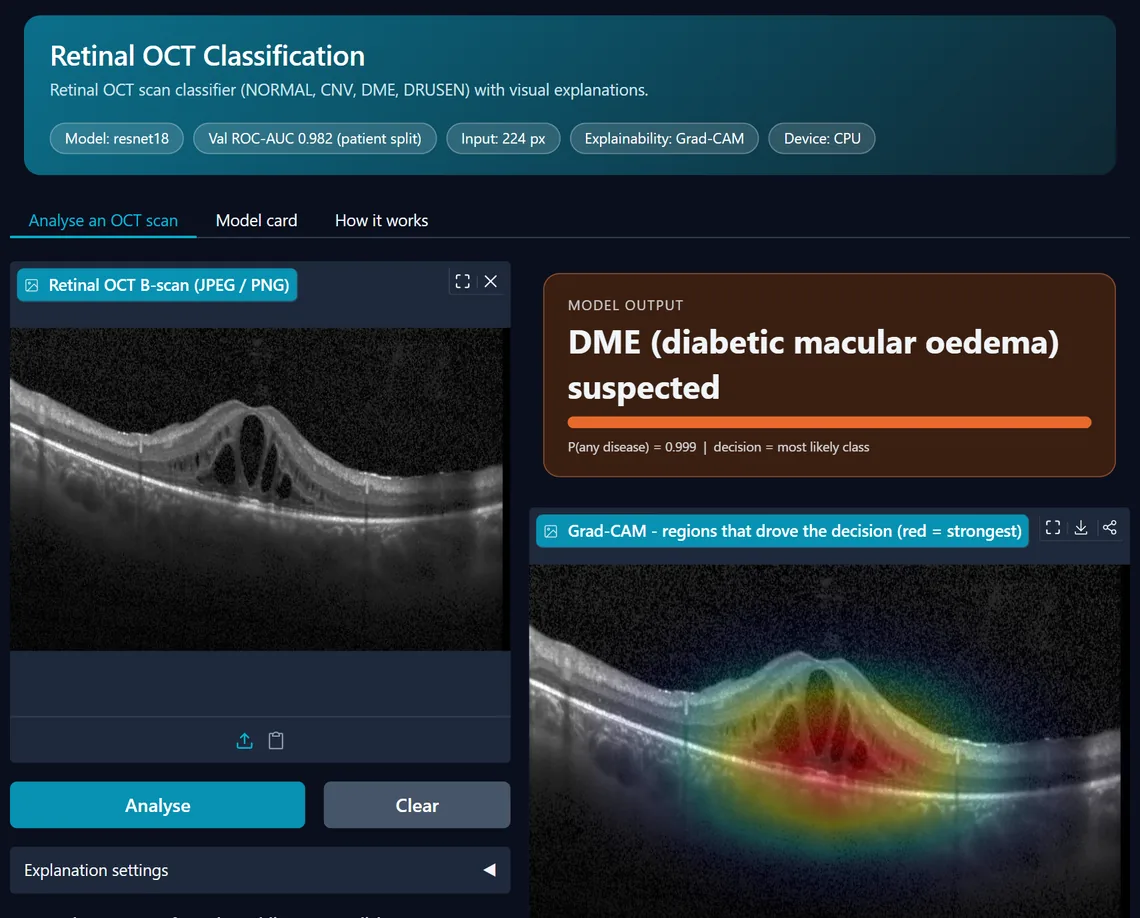
Our honest results
| Accuracy - patient-split validation (6,226 scans) | 0.906 |
| ROC-AUC - patient-split validation | 0.982 |
| Accuracy - official test split (1,000 scans) | 0.999 |
Why the gap? 566 of the 633 official test patients also appear in training, and the test images are unusually clean. Spotting this is a great viva point. Trained in 7.4 min on an RTX 5070 Laptop GPU.
What's included
- Readable source codeSmall, commented modules you can explain line by line in your viva.
- Demo appA local web app to show your examiners - runs offline on your laptop.
- Trained model + reference resultsSo you can compare your own runs fairly.
- Learning guide with viva Q&ABackground, design choices explained, limitations and extension ideas.
- One-click setup & testsWindows setup script and tests that prove it works on your PC.
- Dataset download scriptFetches the public data from its original source, with the citation.
Dataset credit
Kermany D., Zhang K., Goldbaum M. (2018). Labeled Optical Coherence Tomography (OCT) and Chest X-Ray Images for Classification. Mendeley Data, V2. doi:10.17632/rscbjbr9sj.2 - CC BY 4.0.
Academic integrity
We sell code and teaching, not finished projects. You must understand, extend and write up the work yourself, acknowledge the kit and cite the dataset. No ready-made reports.