 VivaKit
IoT Network Intrusion Detection
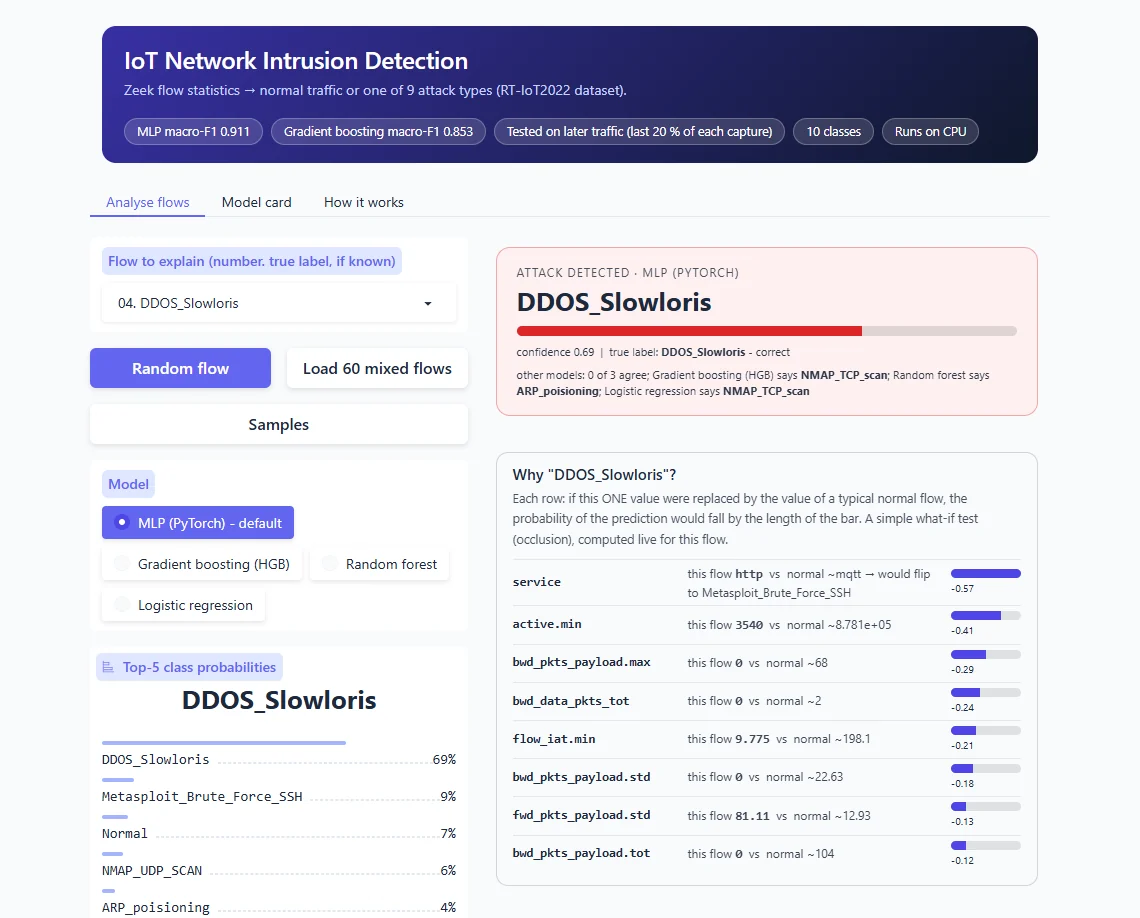
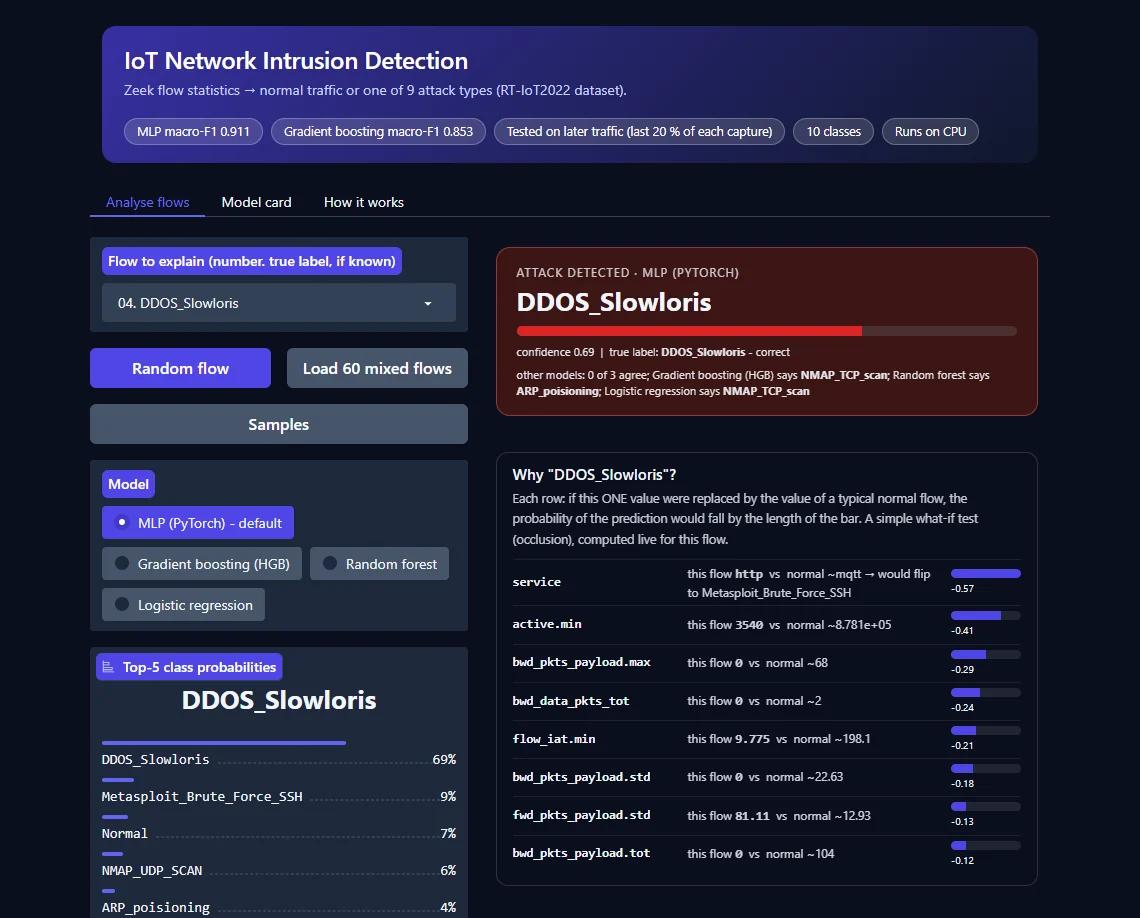
Normal traffic or one of 9 attacks (SYN flood, Slowloris, ARP poisoning, SSH brute force, Nmap scans), predicted from the Zeek statistics of each network flow in the RT-IoT2022 dataset. A baseline, logistic regression, random forest, gradient boosting and a PyTorch MLP are compared on traffic recorded after their training data. Upload a CSV of flows in the demo and see which values drove each prediction.
Secure checkout by Dodo Payments (UPI, cards). Your personalised download link is e-mailed within 24 hours. One purchase covers one project team of up to 4 students. See terms and refunds.
Our honest results
| MLP macro-F1 - 23,594 later test flows, 10 classes | 0.911 |
| Gradient boosting macro-F1 / false-alarm rate | 0.853 / 0.33% |
| Accuracy of always answering "DoS" | 0.764 |
| Random forest, random split vs time-ordered split | 0.972 vs 0.856 |
Shuffle the flows before splitting and the random forest looks 12 points better than it is. The guide also shows which columns leak the answer, and why every tree model misses the late Slowloris traffic that the MLP catches. All models train in about 15 seconds on a laptop CPU.
What's included
- Readable source codeSmall, commented modules you can explain line by line in your viva.
- Demo appA local web app to show your examiners - runs offline on your laptop.
- Trained model + reference resultsSo you can compare your own runs fairly.
- Learning guide with viva Q&ABackground, design choices explained, limitations and extension ideas.
- One-click setup & testsWindows setup script and tests that prove it works on your PC.
- Dataset download scriptFetches the public data from its original source, with the citation.
Dataset credit
S. B. & Nagapadma R. (2023). RT-IoT2022. UCI Machine Learning Repository. doi:10.24432/C5P338 - CC BY 4.0.
Academic integrity
We sell code and teaching, not finished projects. You must understand, extend and write up the work yourself, acknowledge the kit and cite the dataset. No ready-made reports.