 VivaKit
Driver Drowsiness Detection: EAR, PERCLOS, Yawns, Nods
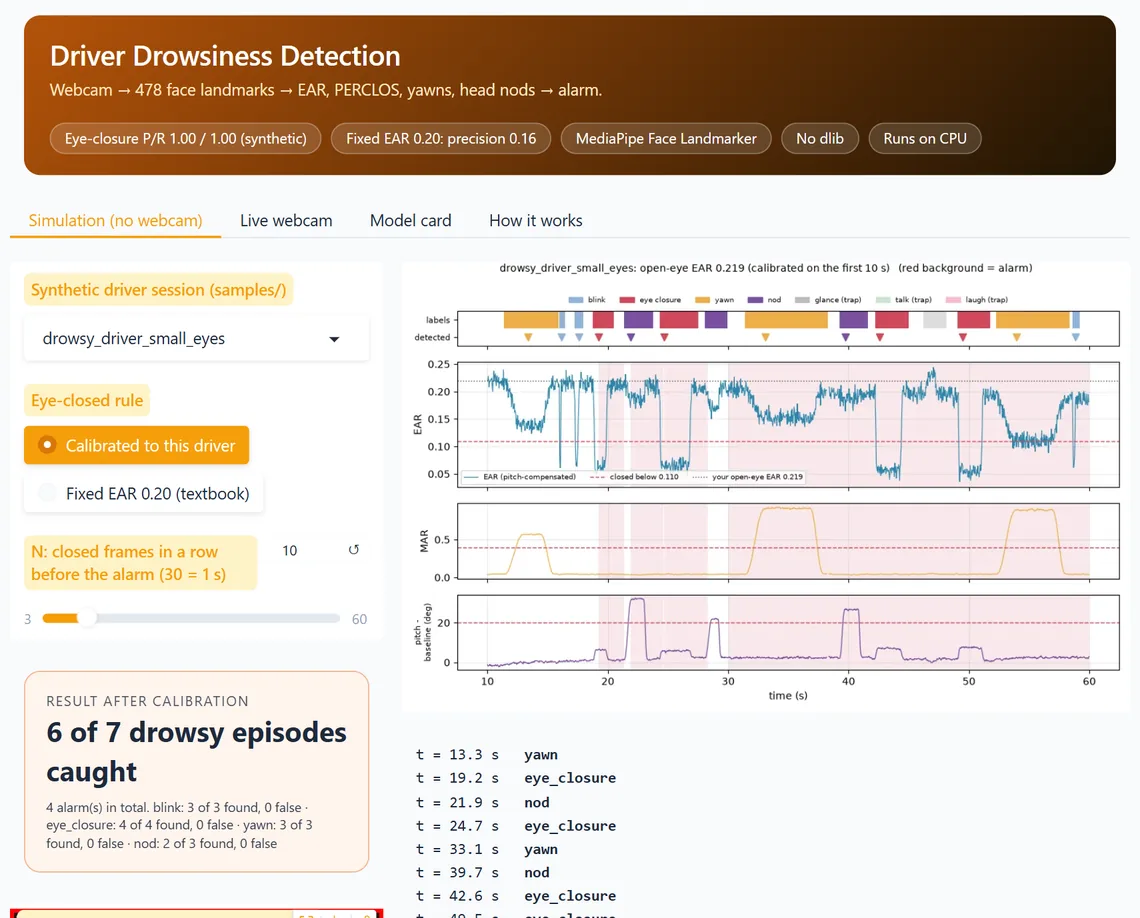
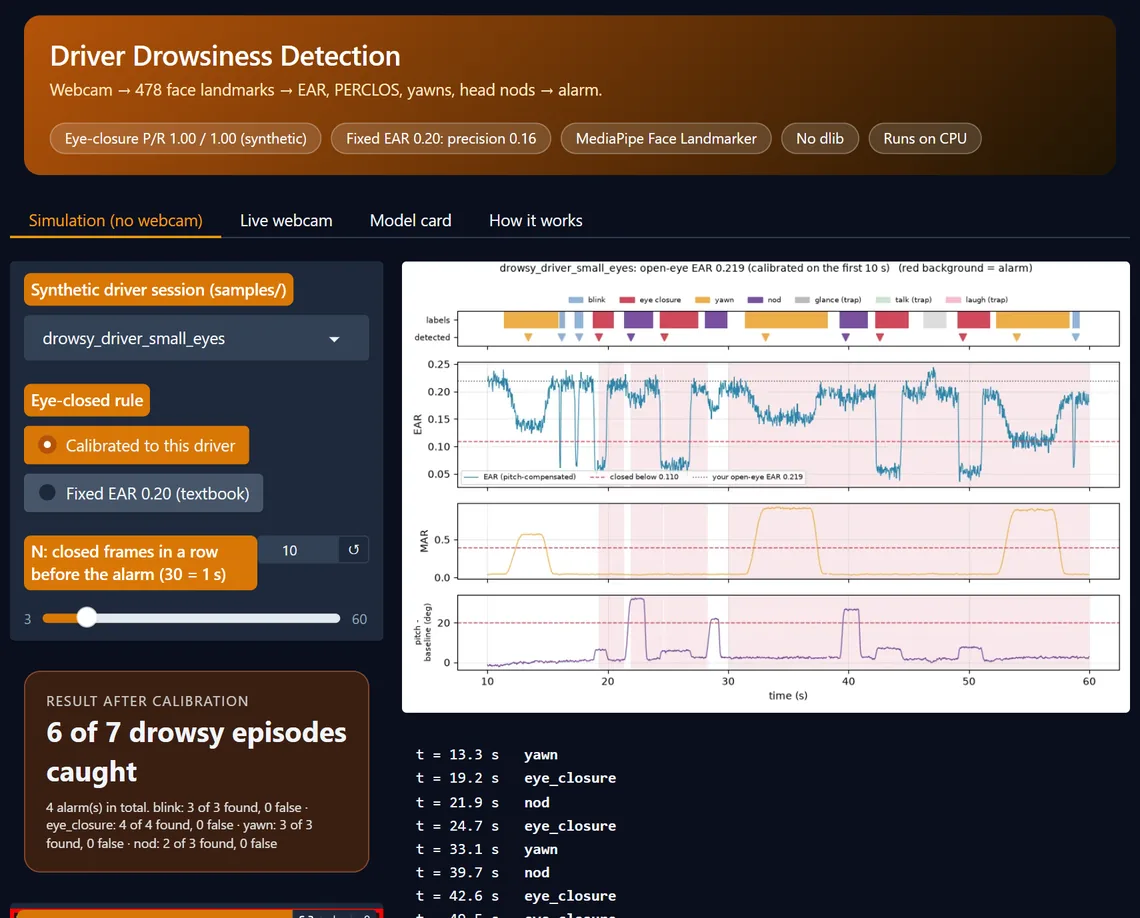
Your project raises a red-screen-and-beep alarm when a webcam sees eyes closing, a yawn or a head nod. It shows, with a fair test on 25 unseen simulated drivers, why calibrating to each driver cuts false alarms from 77 to under 2 per hour compared with the textbook threshold. You can explain every number, and the kit shows you how to record and score your own clips. MediaPipe face landmarks, no dlib.
Secure checkout by Dodo Payments (UPI, cards). Your personalised download link is e-mailed within 24 hours. One purchase covers one project team of up to 4 students. See terms and refunds.
Our honest results
| Eye-closure alarm precision / recall - 25 synthetic test drivers (simulated microsleeps are easy) | 1.000 / 1.000 |
| False alarms per hour on alert drivers: calibrated vs textbook EAR 0.20 | 1.8 vs 77.4 |
| Yawn precision / recall | 0.922 / 1.000 |
| Head-nod recall (the weak spot) | 0.588 |
The numbers come from simulated drivers, not real ones; the guide says so and shows why a fixed EAR threshold fails people with small eyes. A learning project, not a safety device. Runs on a laptop CPU.
What's included
- Readable source codeSmall, commented modules you can explain line by line in your viva.
- Demo appA local web app to show your examiners - runs offline on your laptop.
- Trained model + reference resultsSo you can compare your own runs fairly.
- Learning guide with viva Q&ABackground, design choices explained, limitations and extension ideas.
- One-click setup & testsWindows setup script and tests that prove it works on your PC.
- Dataset download scriptFetches the public data from its original source, with the citation.
Dataset credit
MediaPipe Face Landmarker model by Google, Apache License 2.0 (model and model cards), downloaded at setup, not redistributed. No dataset is used.
Academic integrity
We sell code and teaching, not finished projects. You must understand, extend and write up the work yourself, acknowledge the kit and cite the dataset. No ready-made reports.