 VivaKit
Devanagari Handwritten Character Recognition
Draw a letter with the mouse and a small CNN (PyTorch) reads it live: 46 classes, क to ज्ञ and the digits ० to ९, trained on 92,000 handwritten images. The kit compares the CNN with a plain neural network, tests what augmentation buys, and shows which letters get confused and why (ढ/द, ब/व).
Secure checkout by Dodo Payments (UPI, cards). Your personalised download link is e-mailed within 24 hours. One purchase covers one project team of up to 4 students. See terms and refunds.
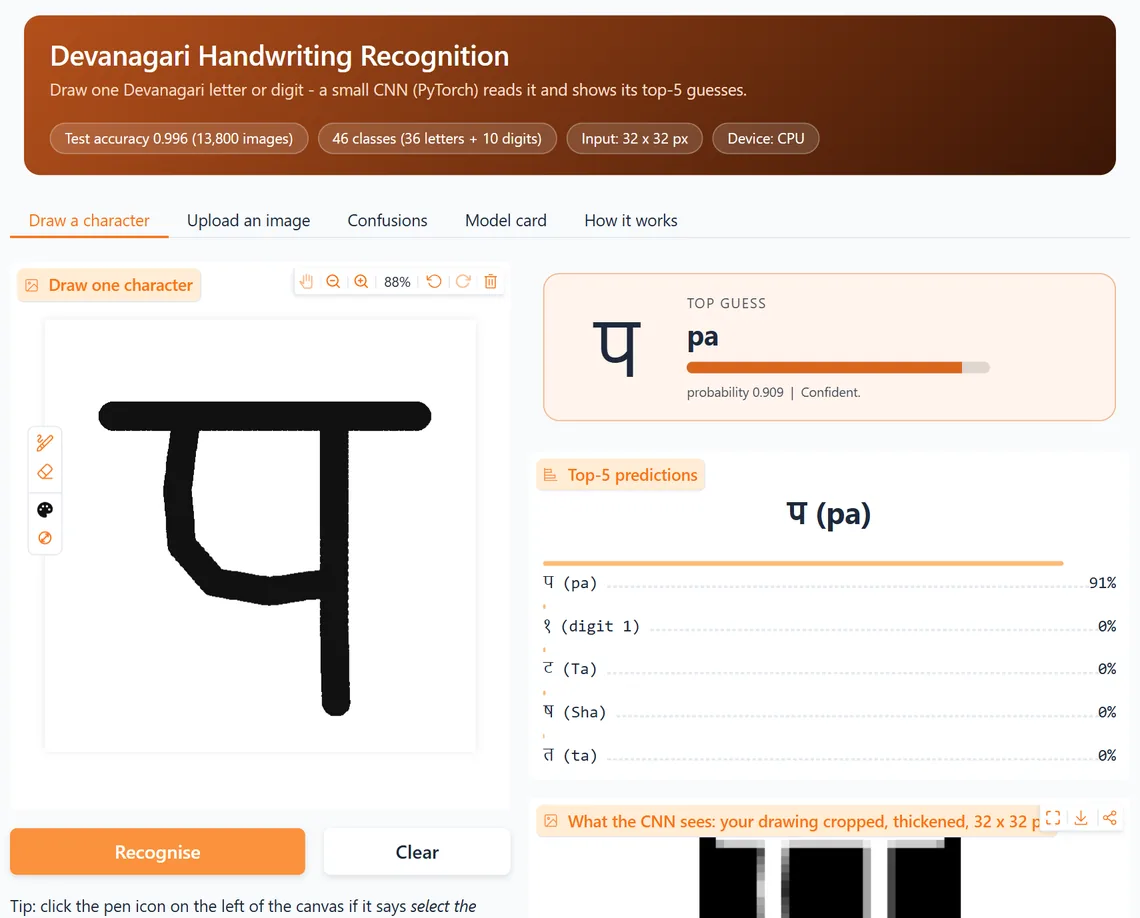
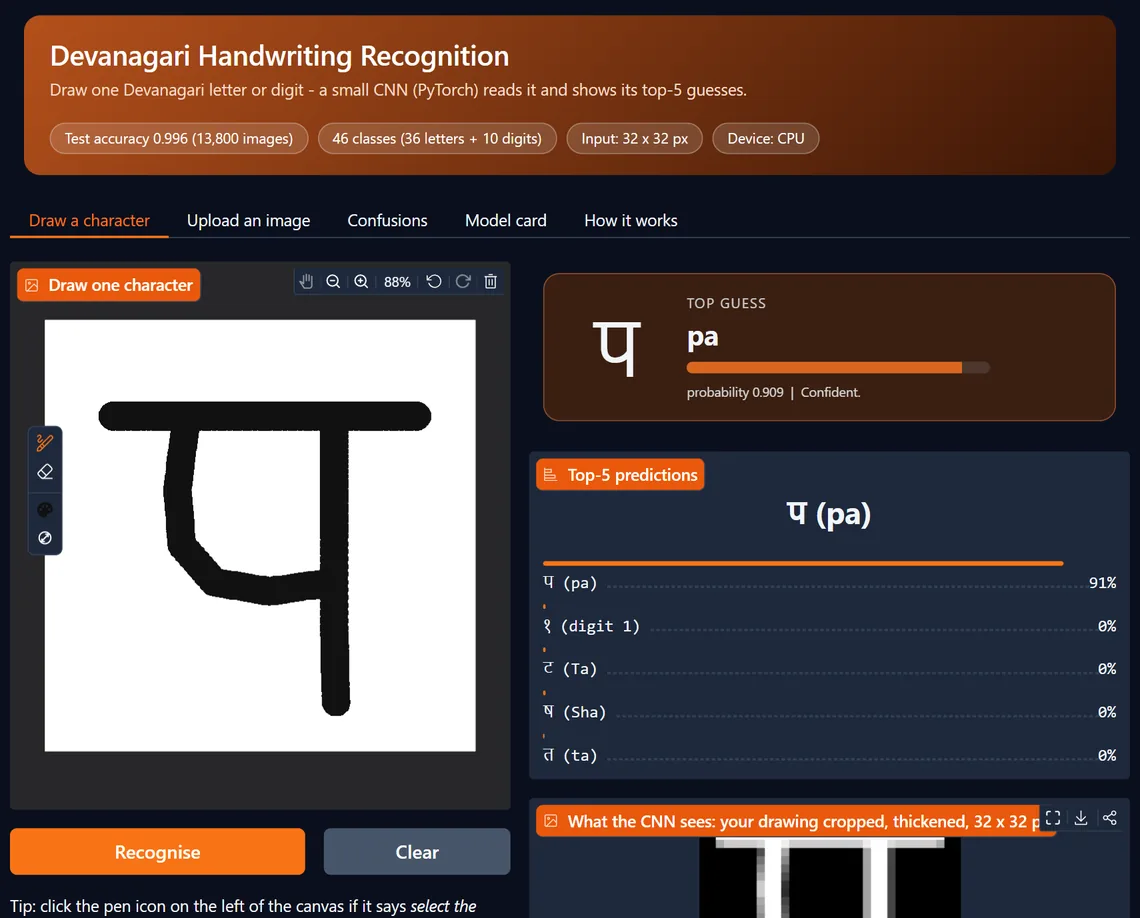
Our honest results
| CNN accuracy - official test split (13,800 images) | 0.9956 |
| Plain neural network (no convolutions), same size | 0.9628 |
| Thin-stroke test: CNN with vs without augmentation | 0.950 vs 0.476 |
Augmentation leaves the clean test score unchanged but saves the model when the pen changes, which makes a good viva point. Trains in 1.6 min on an RTX 5070 Laptop GPU or about 11 min on a laptop CPU, so no GPU is needed.
What's included
- Readable source codeSmall, commented modules you can explain line by line in your viva.
- Demo appA local web app to show your examiners - runs offline on your laptop.
- Trained model + reference resultsSo you can compare your own runs fairly.
- Learning guide with viva Q&ABackground, design choices explained, limitations and extension ideas.
- One-click setup & testsWindows setup script and tests that prove it works on your PC.
- Dataset download scriptFetches the public data from its original source, with the citation.
Dataset credit
Acharya S., Gyawali P. (2015). Devanagari Handwritten Character Dataset. UCI Machine Learning Repository. doi:10.24432/C5XS53 - CC BY 4.0.
Academic integrity
We sell code and teaching, not finished projects. You must understand, extend and write up the work yourself, acknowledge the kit and cite the dataset. No ready-made reports.