 VivaKit
Credit Card Fraud Detection
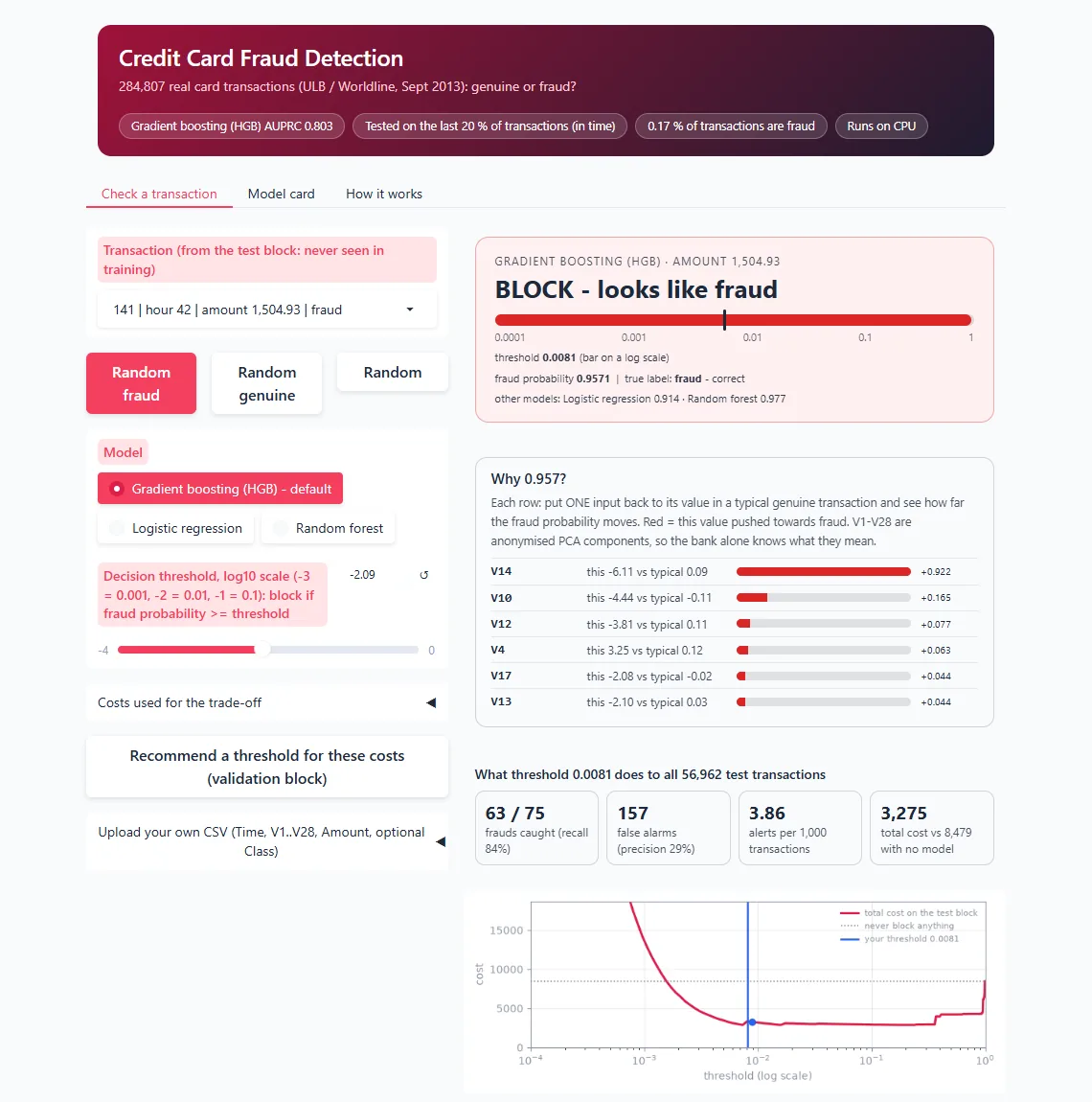
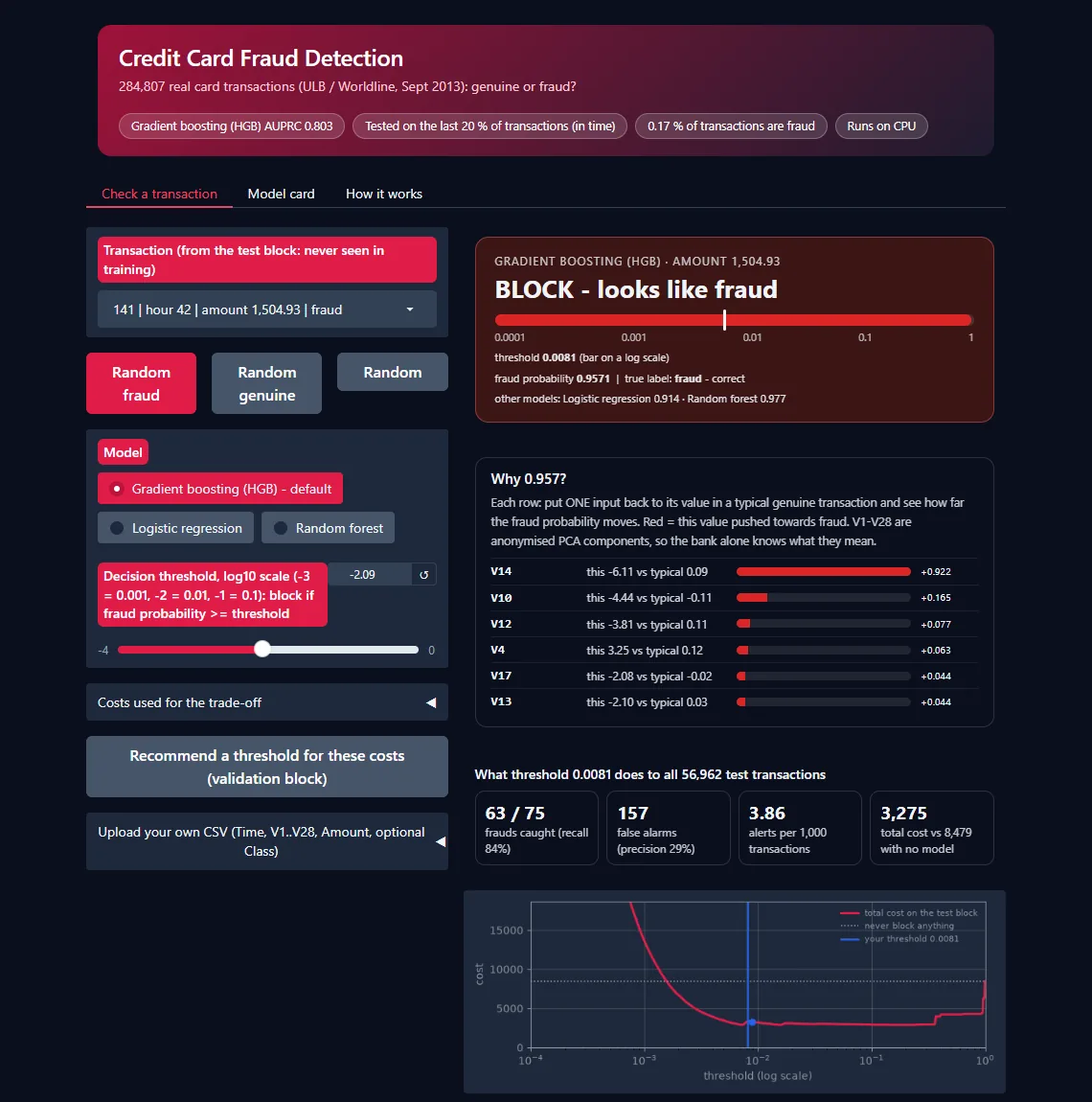
Spot the 75 frauds hidden among 56,962 real card transactions that come later in time than anything the models learnt from. Logistic regression, a random forest and gradient boosting are compared with precision-recall curves instead of misleading accuracy. In the demo you pick a transaction, see its fraud probability and the inputs behind it, and move a threshold slider to watch frauds caught, false alarms and total cost change.
Secure checkout by Dodo Payments (UPI, cards). Your personalised download link is e-mailed within 24 hours. One purchase covers one project team of up to 4 students. See terms and refunds.
Our honest results
| Gradient boosting AUPRC - 56,962 later test transactions | 0.803 |
| Random forest: frauds caught / false alarms at the cost-chosen threshold | 62 of 75 / 84 |
| Accuracy of never blocking anything (catches no fraud) | 99.87% |
| Gradient boosting AUPRC, random split vs time-ordered split | 0.880 vs 0.803 |
Shuffle the transactions before splitting and every model looks better than it is. The guide also shows why a threshold tuned on 57 validation frauds does not transfer perfectly, and gives a bootstrap interval for every score. scikit-learn only: all models train in about 1.5 minutes on a laptop CPU.
What's included
- Readable source codeSmall, commented modules you can explain line by line in your viva.
- Demo appA local web app to show your examiners - runs offline on your laptop.
- Trained model + reference resultsSo you can compare your own runs fairly.
- Learning guide with viva Q&ABackground, design choices explained, limitations and extension ideas.
- One-click setup & testsWindows setup script and tests that prove it works on your PC.
- Dataset download scriptFetches the public data from its original source, with the citation.
Dataset credit
Machine Learning Group of ULB & Worldline, Credit Card Fraud Detection (kaggle.com/datasets/mlg-ulb/creditcardfraud); Dal Pozzolo A., Caelen O., Johnson R. A. & Bontempi G. (2015), IEEE CIDM - database ODbL 1.0, contents DbCL 1.0.
Academic integrity
We sell code and teaching, not finished projects. You must understand, extend and write up the work yourself, acknowledge the kit and cite the dataset. No ready-made reports.