 VivaKit
Air Quality (PM2.5 / AQI) Forecasting
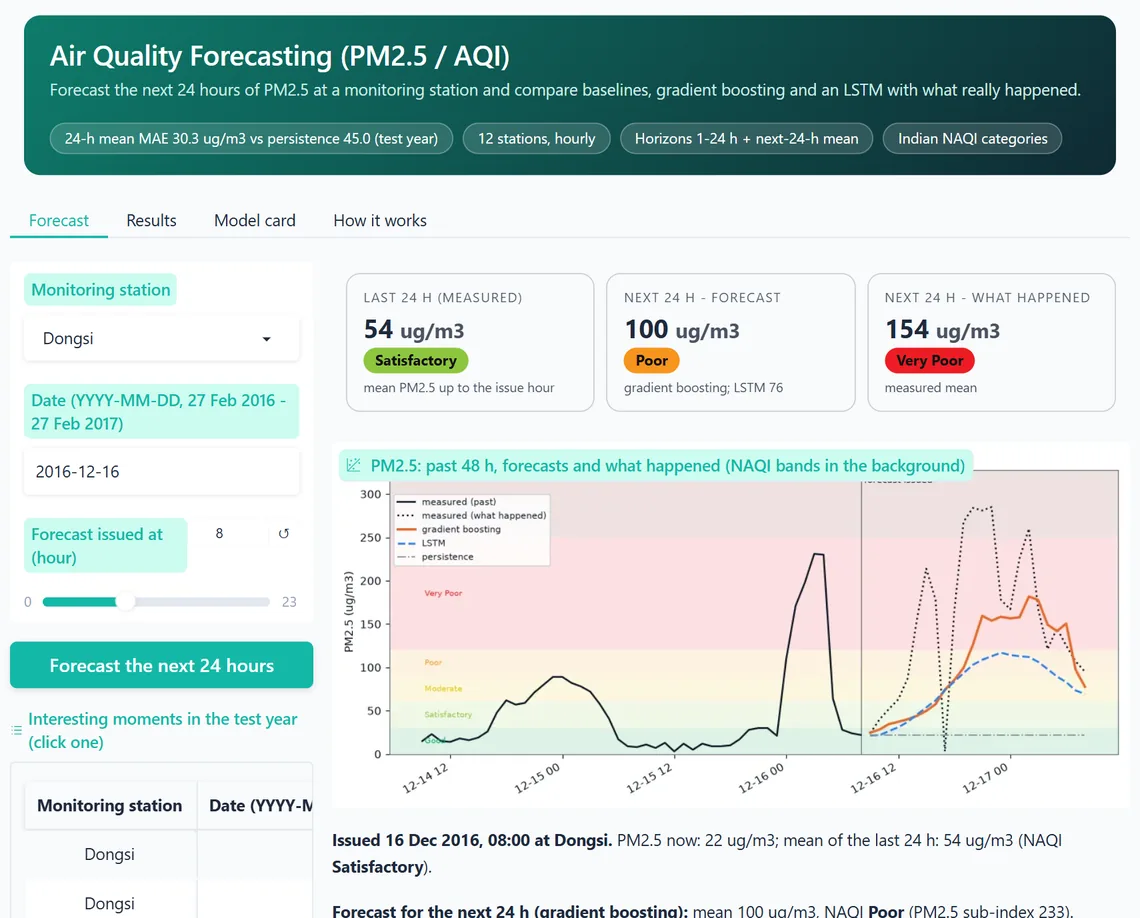
Forecast PM2.5 1 to 24 hours ahead, and the next-24-hour mean that India's National Air Quality Index uses, at 12 monitoring stations (4 years of hourly data). Persistence and same-hour-yesterday baselines, gradient boosting with lag features and a small LSTM are scored on a year they never saw. The demo plots the forecast against what was measured on NAQI colour bands. Load your own city's CSV with one setting.
Secure checkout by Dodo Payments (UPI, cards). Your personalised download link is e-mailed within 24 hours. One purchase covers one project team of up to 4 students. See terms and refunds.
Our honest results
| Next-24-h mean PM2.5 MAE - gradient boosting vs persistence (test year) | 30.3 vs 45.0 µg/m³ |
| NAQI category of the 24-h mean: exact / within one category | 46% / 88% |
| 6 h ahead MAE - gradient boosting vs persistence | 27.9 vs 31.9 µg/m³ |
| Same model, shuffled split instead of time split (24-h mean MAE) | 21.9 vs 30.0 µg/m³ |
Shuffle the hours and the model looks 27% better than it really is. The guide shows why, and why Severe days are under-forecast. Trains in about 3 minutes; no GPU needed. Data: Beijing Multi-Site Air Quality (UCI), because we found no clearly licensed multi-year Indian set to bundle.
What's included
- Readable source codeSmall, commented modules you can explain line by line in your viva.
- Demo appA local web app to show your examiners - runs offline on your laptop.
- Trained model + reference resultsSo you can compare your own runs fairly.
- Learning guide with viva Q&ABackground, design choices explained, limitations and extension ideas.
- One-click setup & testsWindows setup script and tests that prove it works on your PC.
- Dataset download scriptFetches the public data from its original source, with the citation.
Dataset credit
Chen S. (2017). Beijing Multi-Site Air Quality. UCI Machine Learning Repository. doi:10.24432/C5RK5G - CC BY 4.0.
Academic integrity
We sell code and teaching, not finished projects. You must understand, extend and write up the work yourself, acknowledge the kit and cite the dataset. No ready-made reports.